verifier The verifier
Before anyone writes code, it turns the story’s criteria into tests. At the end it uses the app the way your customer would. It’s the only one that can say “done”.
 Keelokit
Open source · a Claude Code harness
Claude Code writes code. Keelokit makes it work like a disciplined team: it writes things down, tests, reviews itself and ships nothing without your OK.
For startups and teams who want a first MVP built right, and for anyone starting out with agents. It’s the method I use on my own projects.
Orchestrating sessions that can’t see each other? Keelokit Harbor is the other plugin
Latest release: v0.13.0 · Nov 2, 2026 · What’s new · Download .zip
What you build rides on top. What keeps it on course sits underneath.
−2 m
Keelokit is the playbook you install in it, like the one you’d hand someone joining your team: the same stages, the same rules, and someone who checks every delivery.
Claude Code on its own
Ask it to “build me an app” and it will. Its own way each time, with nothing written down, and the one who built it tells you it’s ready.
With Keelokit
First it understands what you want and writes it down. Then it builds in small pieces, with tests, with another agent reviewing and another trying to break it. You approve what matters.
−4 m
You your part: answer and approve Claude does it on its own
It asks about your idea and writes down what problem it solves, for whom and under which rules. What nobody knows yet stays as an open question.
YouClaudeA short document of what gets built and what doesn’t, and how you’ll measure whether it works.
ClaudeYou approveThe project’s structure, with tests and automatic checks from day one.
ClaudeThe work split into small stories, each with its “done when…”.
ClaudeStory by story, with a team of agents that check each other.
ClaudeIt looks for bugs and security holes. Every kind of bug it finds leaves a check so it doesn’t come back.
ClaudeFirst to a test copy. To your users, only when you approve it.
ClaudeYou approveYou choose once how it works: stage by stage, stopping at each one for your review, or automatic, stopping only where a person is needed: questions only you can answer, accounts, money, production.
−6 m
Each role is a different agent with its own job, and none of them grades its own work.
verifier Before anyone writes code, it turns the story’s criteria into tests. At the end it uses the app the way your customer would. It’s the only one that can say “done”.
general agent Writes code until the tests pass. It didn’t write them, and it doesn’t decide when it’s finished.
reviewer Reads the code cold against the story and the house rules, like a colleague who didn’t write it.
breaker Tries to break it: two clicks in a row, two requests at once, a user from another account, the edge of every limit.
context-auditor Before anything is built, it reads the context and the PRD like an outsider: what’s missing, what contradicts itself.
The agent that writes the code can’t close a task until another agent has reviewed it.
−8 m
Keelokit has no server of its own and collects nothing. Everything stays on your computer and in your accounts.
Your computer
Claude Code runs there with Keelokit. That’s where the code is written and the app is tried out while it’s built.
GitHub
Fly.io
The server on the internet for the back of the app, the part that handles requests, and its database.
−10 m
New in 0.8
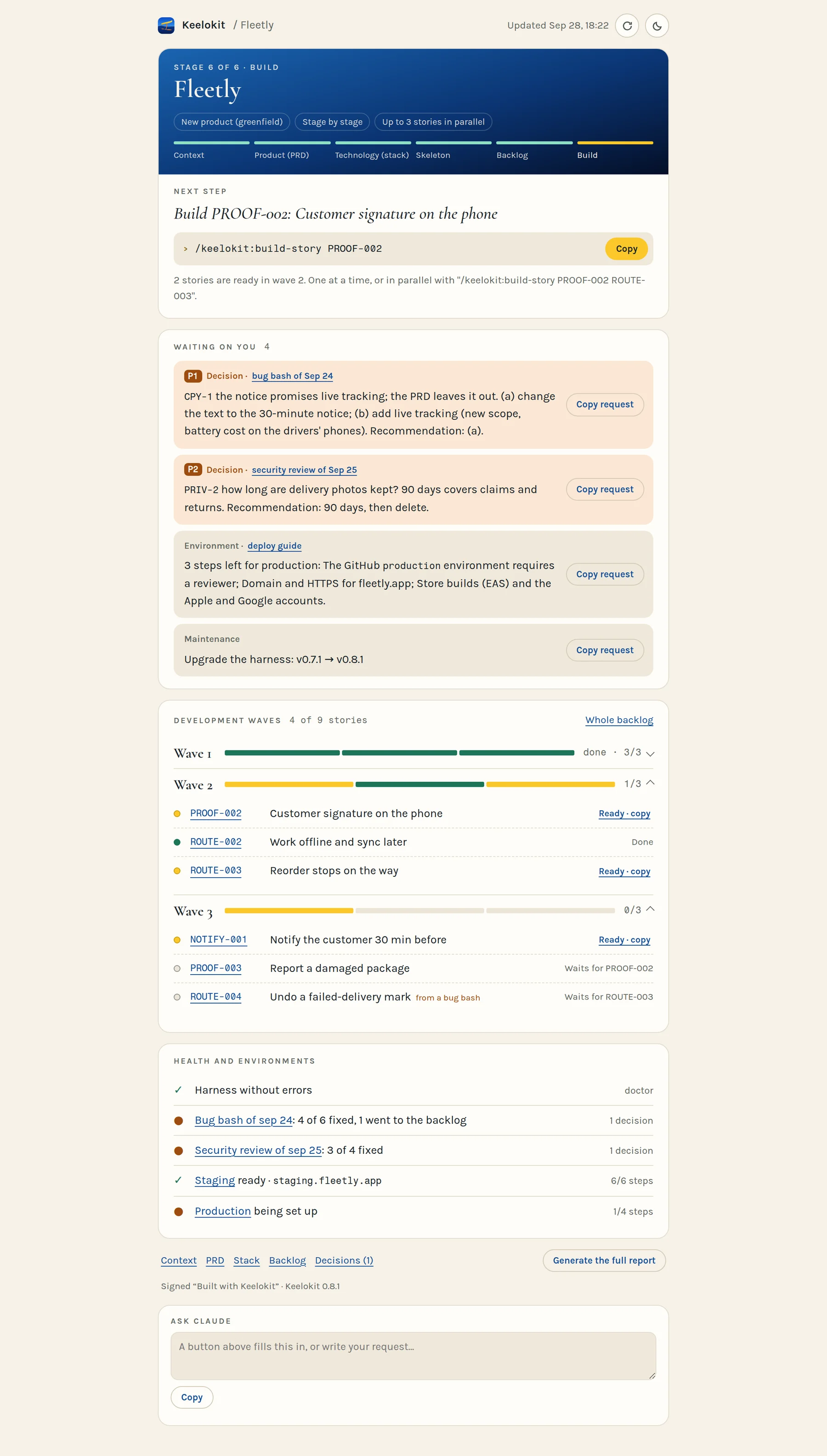
/keelokit:project-dashboard builds a short page from your repo, in your language: where the project is, the next step, what waits for you. It stays live and light, so following a project costs very few tokens. /keelokit:project-report generates the complete status, read-only, to share.
−12 m
New in 0.9
/keelokit:run-local starts the database and the API and opens your app on an Android phone, an emulator or the iOS simulator. It checks what your Mac is missing and installs it after one yes.
macOS for now. Launched on a Galaxy S20 over USB and on the iOS simulator.
−14 m
In my experience, agents tend to close stories and leave a trail of bugs behind them, bugs they neither write down nor mention. That’s where these four ideas came from.
Each rule points to something that verifies it: a test, a lint rule, a git hook, a CI job.
What nobody knows yet is written down with an owner, not guessed.
One agent writes the tests first, another reads the diff cold, another tries to break it.
Each bug that escapes leaves a check for its whole class, so it can’t come back.
−16 m
Not to use it. To install it, a little: you need Node, Python, Docker and git, on macOS or Linux, and you use it from the terminal. If you’ve never opened one, ask someone to help the first time. After that, Claude guides you.
Keelokit is free and open source. You pay for your Claude plan, which gets more use than a regular chat because several agents work on each story, and for hosting the app. Claude asks before creating anything paid.
In your repository and your accounts. Keelokit has no server of its own and collects nothing.
/keelokit:project-adopt adds the rules and the checks to your repo without rewriting your code. If your stack is different, you get the rules and the checks, but not the skeleton.
| What you have | Start with | What you get |
|---|---|---|
| An idea, nothing else | /keelokit:project-new | A monorepo that runs, with CI, context and a first backlog |
| A repo you already have | /keelokit:project-adopt | The rules mapped to its checks, and the rest as dated debt |
| A story to build | /keelokit:build-story | Tests written first, code that passes them, a verified result |
| A project to follow | /keelokit:project-dashboard | A light, live page: the next step to copy, what waits for you, every wave and its stories |
−17 m
It’s built around my preferences and my stack. It won’t fit every project or every team. If your stack is different, /keelokit:project-adopt still gives you the rules and the checks.
build-story and check-bugbash run several agents per story. /keelokit:build-story --light exists for small changes.
It stops agents from the obvious mistakes, but it isn’t a sandbox. Git hooks and CI are the real backstop.
It can tell a check exists and is switched on, not that it’s a good check. For critical code, mutation testing measures that; elsewhere, reviews and bug hunts cover it.
−18 m
claude plugin marketplace add leosimini/keelokit claude plugin install keelokit@keelokitIn an empty folder run /keelokit:project-new. In a repo you already have, /keelokit:project-adopt.
You need Node 22 with pnpm 10, Python 3.11+, uv, Docker and git. macOS or Linux.
Download .zipCode, docs and license on GitHub
The download is keelokit-plugin.zip, the plugin ready to install: in Claude, Customize → Plugins → Upload. Each version’s zip is on its GitHub release.
Orchestrating sessions that can’t see each other? Keelokit Harbor is the other plugin